
Pressure from above and below: Understanding the Root and Head Centres in Human Design
Before we go any further, if you don’t know your Human Design, all you need is your date, place and exact time of birth and you can generate your chart for free HERE. I suggest saving your chart somewhere handy so that you can refer back to it as you read through this article.
I have pressure on my mind today.
Because as I sat down to write this post, I was met with a blank page.
No ideas. No clear thread.
Just the quiet hum of…“you need to have something meaningful to say.”
In other words….pressure.
And as so often happens, the more I tried to think of something, the emptier my mind felt.
There are past versions of me who’d have sat at my laptop in a state of force. But if I’ve learned anything, it’s that this is no good for anyone.
So I did what I always do.
I shut the laptop and took myself to the beach.
And as I wandered, I allowed my mind to wander too. No agenda. Simply following the breadcrumbs.
Which brought me to pressure.
And the paradox that the more pressure we feel, whether self-imposed or external, the harder it becomes to achieve what we are trying to achieve.
The more pressure we feel, the more constricted we become.
The more force we apply, the less we flow.
The more we try, the more it seemingly slips through our fingers.
And then the irony that it’s often in the innocuous moments, the simple moments, the moments when no one is watching and there is no expectation — and no pressure — that we receive. The ideas. The answers. The inspiration. The creativity.
When you turn the house upside down trying to find something you’ve lost. Give up. And then suddenly remember where you left it.
You wrestle with a problem for hours. And the solution arrives suddenly while you’re in the shower, driving or folding laundry.
You do something effortlessly when alone, but the moment someone watches, your fingers fumble, your words stumble.
Pressure changes the state of your system.
For me, I also notice pressure show up in the way I work, write and create. At 10am on a Tuesday morning when I “should” be working, I find myself with no motivation or energy. But weekends, evenings — times when there is no pressure or expectation to be productive — are the times when I feel the most inspired.
From a hypnotherapy lens, I see this as the interplay between the conscious and subconscious mind.
The conscious mind is the part that tries. It analyses. It pushes. It problem-solves. It is logical. It wants an outcome.
But the subconscious mind is where creativity lives. It connects patterns. It stores memory. It makes intuitive leaps without effort.
The more the conscious mind tightens its grip — “I need an idea.” “I need the answer.” “This has to work.” — the more it restricts access to the subconscious.
But in those moments when we are driving, showering, walking on the beach, folding laundry, knitting, sewing, painting — when the conscious mind relaxes its demand — the subconscious is given space to rise.
And that’s often when the insight appears.
Not because we forced it, but because we stopped looking for it.
And then when I look at this through the lens of Human Design, it makes even more sense.
Because in Human Design, there are two pressure centres: the root centre and the head centre which top and tail the BodyGraph. The root centre provides pressure from below and the head centre provides pressure from above. The root centre is the pressure to do. The head centre is the pressure to think.
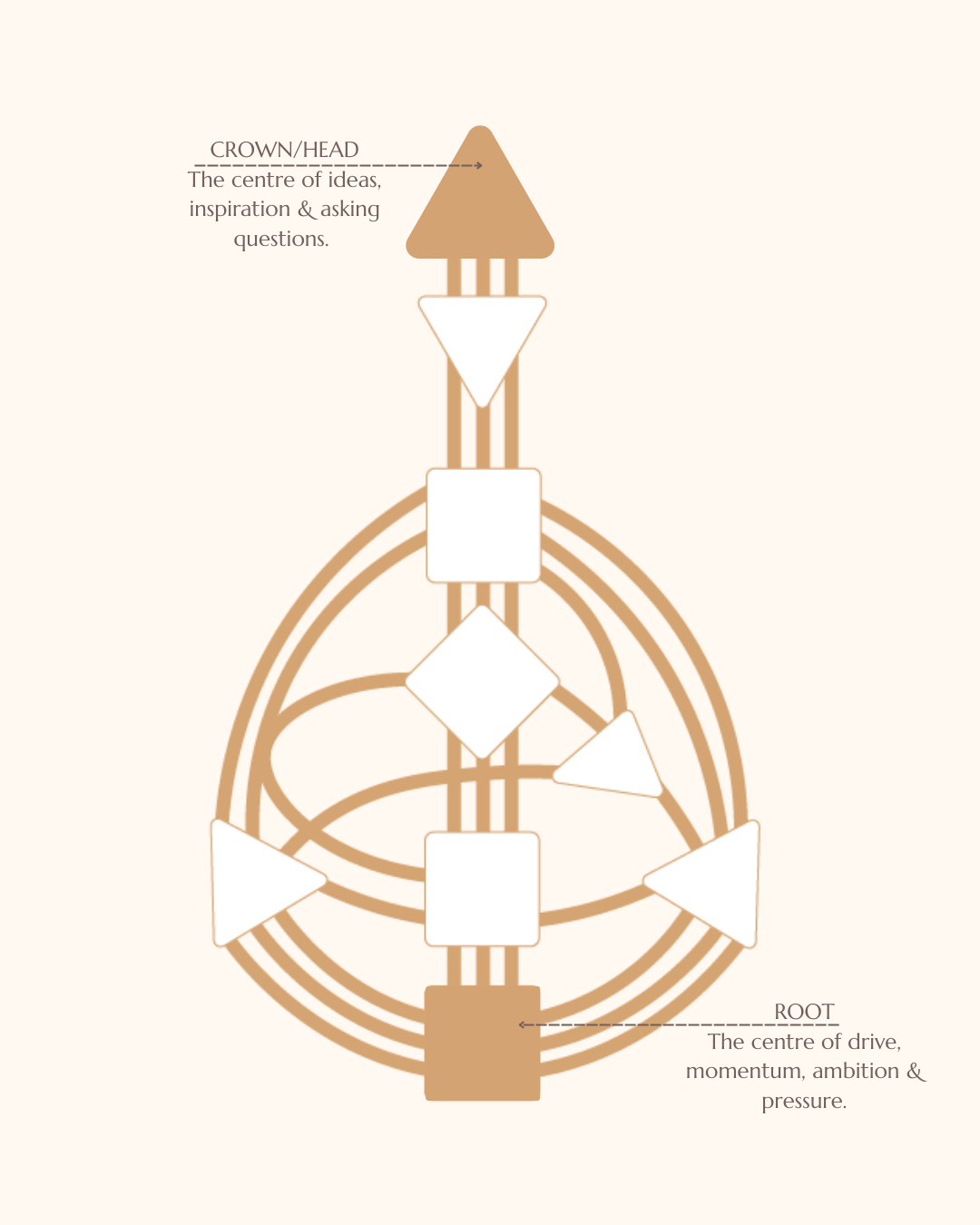
The Root Centre
The root centre governs themes of drive, ambition, momentum, stress and adrenaline. It is the pressure to get things in motion. To move. To act. To resolve.
The pressure to do.
Defined Root
With a defined root, you generate steady pressure and drive from within. You have a consistent source of momentum that fuels action, progress and endurance.
There is a natural rhythm to the way you process and manage stress, pressure and drive. Pressure doesn’t necessarily overwhelm you because you have a reliable way of processing it, and this allows you to stay relatively calm, grounded and stable even when experiencing pressure.
With a defined root, it’s also interesting to consider what centre, or centres, your root is connected to, and via which channels, as this will give you an idea of the flavour of pressure you experience.
For example, if the root centre is connected to the spleen, it applies pressure to the splenic themes of health, survival, instinct and safety. If the root centre is connected to the sacral, there can be pressure to respond, to work, to use energy. If the root centre is connected to the solar plexus, it applies pressure to understand, process and resolve emotional tension.
Undefined Root
With an undefined root, you do not have a consistent internal pressure system. Instead, you amplify external stress and urgency.
With an undefined root, you can feel intense pressure. But the thing is, it’s most often not yours, but rather the stress and pressure you are picking up for your environment and the people around you. This may lead you to feel rushed when nothing is actually urgent, to take on other people’s timelines, to struggle to rest when others around you are busy, and to feel an almost compulsive urge to clear your to-do list.
With an undefined root, there is a tendency to feel pressure to relieve pressure —“I’ll just finish this, and then I’ll relax.”
But of course the relief is short-lived because as soon as one thing is done, another replaces it….and the pressure continues.
The Head Centre
If the root centre is the pressure to do, the head centre is the pressure to think.
The head centre sits at the very top of the BodyGraph and governs inspiration, questions, ideas, curiosity and the mental pressure to make sense of life and resolve uncertainty through thinking.
The head is not a centre for answers, it is a centre for questions…..but it applies pressure to the ajna to find the answers.
Defined Head
With a defined head, you have a consistent and reliable source of mental pressure and inspiration. Your mind works in a steady way. The kinds of questions that inspire you tend to be similar and familiar, and the way you think about these questions also tends to be consistent and familiar. You don’t necessarily feel pulled in every direction by every external idea, there’s a natural filtering process that happens. The pressure you feel is steady and consistent, but not urgent. The shadow here can be over-identifying with your way of thinking or assuming your way of processing is the only way.
Undefined Head
With an undefined head, your mind is open and permeable. You are receptive to inspiration from the environment. You amplify other people’s questions. You can feel mental pressure that isn’t actually yours. And this is where pressure can become distorted. Perhaps pressure to answer questions that were never yours to solve, pressure to be certain, pressure to figure it out, pressure to follow every idea.
If the undefined root tries to eliminate pressure by doing, the undefined head tries to eliminate uncertainty by thinking.
So how do you take the pressure off?
I won’t tell you to just relax because we all know that is never helpful. If anything, being told, or trying to tell yourself, to relax, simply adds another layer of pressure.
But I will share what I see through the lens of Human Design, and also what I’ve lived:
Step 1: Notice
Everything starts here. Notice the pressure.
Most people move through life driven by these subtle pressures without ever really recognising them, instead assuming this is “just the way I am.”
Awareness interrupts the pattern.
And Human Design is what supports this awareness — it doesn’t remove the pressure, but it does help you to recognise it.
Step 2: Allow
What happens next is that many will notice the uncomfortable feeling of pressure or stress, and they will try to push it away, stuff it down, ignore it or criticise themselves for feeling this way. But pressure, like any uncomfortable emotion, needs to be acknowledged, allowed and accepted before it can loosen.
So once you’ve become aware of the pressure, bring your attention to it, allow its presence. Just being with the feeling often softens its intensity.
Step 3: Curiosity
This is where you could step into curiosity. Ask yourself: What expectation am I holding onto? Whose expectation is this? Is this pressure mine? Where am I gripping to a certain outcome? What am I afraid will happen if I don’t achieve this outcome? Is this true?
Step 4: Surrender
Then comes surrender. And this doesn’t mean not caring, but rather releasing the expectation of how things should go so that you can stay open to how they could go.
And what I’ll say here, and have learned myself, is that you can’t be sneaky with this.
You can’t manipulate surrender.
“I’ll just relax so inspiration comes.”
“I’ll let it go so the thing arrives.”
“I’ll stop caring so then I’ll get it.”
This is still pressure…just disguised.
True surrender is being okay if nothing comes. Being okay if there is no answer. Being okay if it doesn’t happen.
As today showed me, I went to the beach looking for nothing.
And found this.
So an invitation for you this week, to consider and reflect on how you experience pressure? How does it show up for you? Are your root and head centres defined or undefined? And how does this influence your experience of pressure?
As always, if you’d like some support in understanding your Human Design and applying it to real life, you can book a reading with me here.
With love,
Alice x